

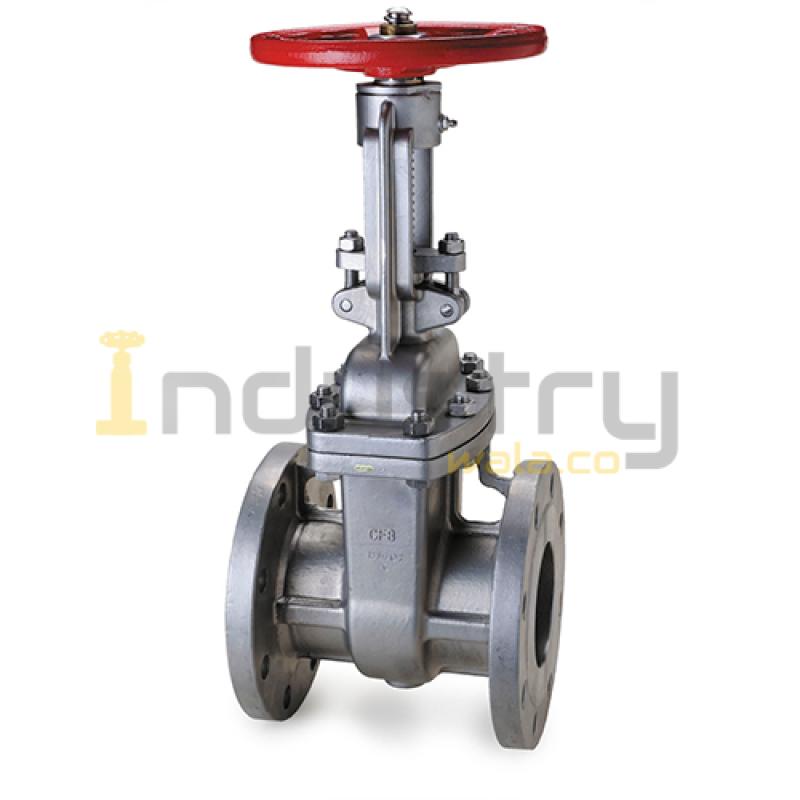
Gate valve is a control valve that either allows media to flow through unobstructed or stops the fluid flow. The main advantage of a gate valve is the straight-through unobstructed passageway, which induces minimal pressure loss across the valve. The unobstructed bore of a gate valve also allows a pig to pass through during pipe cleaning procedures, unlike butterfly valves. In many industrial systems, an SS 304 flange end gate valve is commonly used due to its corrosion resistance and reliable shut-off performance.
However, gate valves are slower than quarter-turn valves and should only be used in the fully open or closed position, not to regulate the flow.
Automated gate valves exist with either an electric or pneumatic actuator, but a manual gate valve is cost-effective since gate valves are typically used infrequently. Gate valves are also commonly referred to as sluice gate valves. Because of their durability and stainless steel construction, many industries compare the stainless steel CF8 gate valve price before selecting the right valve for their applications.
Gate Valve Operation
A gate valve operates similarly to other valves. To open the valve, turn the handwheel (A), which moves the gate (G) up or down on the stem (B) via the threads. A gate valve requires more than one 360° turn to open or close the valve fully. When the gate is lifted up, it opens the inlet to the outlet allowing an unobstructed passageway for the media to flow. When the gate is lowered, it closes and blocks the media flow.
The relationship between the gate's vertical travel and the flow rate is nonlinear for a gate valve, with the greatest changes occurring near complete closure. When used to regulate flow, the relatively high velocity at partial opening results in gate and seat wear, which along with possible vibrations of the gate, shortens the valve's service life. Therefore, a gate valve should only be used for on/off control.
For high-pressure industrial pipelines, many buyers prefer to buy SS 304 gate valve class 300 models as they provide strong construction, reliable sealing, and long service life in demanding applications.