

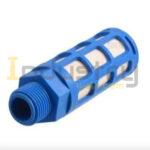
Pneumatic Silencer (PVC)
Link to Bronze / brass conical long head silencer.
Link to bronze / brass adjustable flow silencers.
Link to Bronze / brass flat head / button type silencers.
Price range: ₹28 through ₹91 Exclusive GST
You save (%)
What is a PVC pneumatic silencer?
PVC pneumatic silencer, also called mufflers, safely and quietly vent pressurized air to atmosphere. They are commonly installed on air valves, cylinders, manifolds and fittings. Without a muffler, air exhausting from many types of pneumatic-powered equipment can be so loud as to be detrimental to the surrounding environment and potentially harm workers.
Noise results when fast-moving, turbulent air exiting a port collides with the surrounding static air. Unsilenced pneumatic exhaust can be considered an air jet. In most industrial setting airflow exits at a constant velocity through an orifice and generates noise, related to the choking effect of the port and velocity. Acoustic power (noise) is a product of factors like air density and turbulence and, especially, velocity, which has an exponential effect (≈ V6) on noise generation. And above about 25 psi (2 bar), reducing pressure has minimal effect on noise abatement.
Use of pneumatic silencer:
Thus, mufflers are usually needed. Typically, the devices are installed directly at the exhaust port and diffuse the released air through a porous material that increases the surface area which, in turn, reduces velocity, turbulence and noise levels. These silencers can reduce the noise from pneumatic equipment by 15 to 35 dB[A] compared to an unmuffled outlet. This is significant. Keep in mind that a 10 dB(A) reduction equates to cutting the sound level in half.
Mufflers can be constructed of plastic or metals like brass and stainless steel. They come in differing versions depending on the application. Common design styles include cone, flat-face and cylindrical shapes.
Plastic units usually have injected-molded bodies with plastic fibers or sintered plastic or metal powder inside as the noise-reducing medium. They tend to be economical, lightweight and offer high chemical resistance, and often better noise reduction than same-size metal products.
General-purpose brass products often have machined metal bodies with sintered bronze powder or compacted metal wool as the silencing material. They generally handle temperatures to about 300° F.
Chek out more models of pneumatic silencer by clicking here
FAQs – Pneumatic Silencer (PVC)
How does a pu fitting simplify the installation of a PVC pneumatic silencer?
A pu fitting allows quick push-to-connect installation of the PVC pneumatic silencer, ensuring a secure and leak-free connection in pneumatic systems.
Is a pu fitting suitable for maintaining optimal airflow in a PVC pneumatic silencer?
Yes, a pu fitting ensures a tight connection, helping the PVC pneumatic silencer maintain efficient airflow while reducing exhaust noise.
Does using a pu fitting enhance the durability of a PVC pneumatic silencer setup?
A pu fitting resists vibration and wear, supporting long-term durability and stable performance of the PVC pneumatic silencer in industrial applications.
Can a pu fitting help improve the performance of a PVC pneumatic silencer in high-pressure systems?
Yes, a pu fitting provides precise and reliable connections, allowing the PVC pneumatic silencer to function efficiently even under high-pressure pneumatic conditions.
4 reviews for Pneumatic Silencer (PVC)
 Pneumatic Silencer (PVC)
Related products
-
Pneumatics, Solenoid Valves, Valves
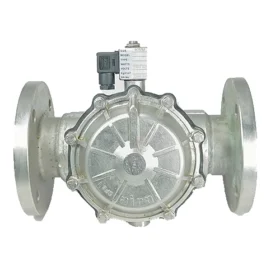
Pilot Operated Diaphragm Type Solenoid Valve Upto 12 Bar Pressure Flange End Aira ISF 1/2″ to 2″
 Pneumatics, Solenoid Valves, Valves
Pilot Operated Diaphragm Type Solenoid Valve Upto 12 Bar Pressure Flange End Aira ISF 1/2″ to 2″
Brand : Aira
Model : ISF
Body MOC : CF8
Diaphragm : Nitrile
Media : Air, Water, Oil and Gas
Pressure : 0.7 to 12KG/Cm2
Temeprature : Upto 85CFor more types of solenoid valves, click here.
SKU: b02ed7296900 -
Pneumatics, Solenoid Valves, Valves
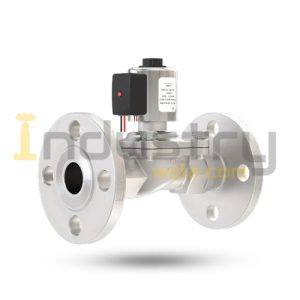
Diaphragm Solenoid Valves For High Temperature Upto 170°C Flange End Normally Closed Aira GTD 1/2″ to 2″
 Pneumatics, Solenoid Valves, Valves
Diaphragm Solenoid Valves For High Temperature Upto 170°C Flange End Normally Closed Aira GTD 1/2″ to 2″
This Solenoid valve works at gravitational pressure that is, 0kg pressure is required to operate this valve.
Brand : Aira
Model : GTD
Body MOC : CF8
Diaphragm : PTFE
Media : Steam
Pressure : 0 to 5KG/Cm2
Temeprature : Upto 170CFor more types of solenoid valves, click here.
SKU: 163bb3957d68 -
Pneumatics, Solenoid Valves, Valves
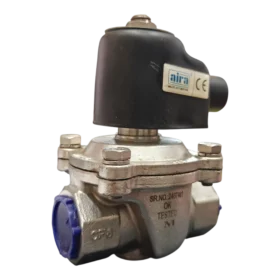
Diaphragm Type Solenoid Valve For Low pressure Aira GSD 1/2″ to 2″
 Pneumatics, Solenoid Valves, Valves
Diaphragm Type Solenoid Valve For Low pressure Aira GSD 1/2″ to 2″
This Solenoid valve works at gravitational pressure that is, 0kg pressure is required to operate this valve.
Brand : Aira
Model : GSD
Body MOC : CF8
Diaphragm : Nitrile
Media : Air, Water, Oil and Gas
Pressure : 0 to 5KG/Cm2
Temeprature : Upto 85CFor more types of solenoid valves, click here.
SKU: eb6cbf6c3146
This pneumatic silencer (PVC) is perfect for basic industrial and automation tasks. It keeps the exhaust quiet and maintains a clean airflow. Light, reliable, and definitely worth adding to any pneumatic system.
This pneumatic silencer works perfectly for reducing exhaust noise in my air line system. The PVC silencer design is lightweight yet durable, and it fits easily on standard pneumatic valves. Great performance at a budget-friendly price.
The air exhaust silencer quality is really impressive. Even though it’s made of PVC, it handles airflow smoothly and reduces noise significantly. Very easy to install and ideal for compressors and small pneumatic setups.
I bought this pneumatic muffler for my workshop, and it works exactly as expected. The airflow remains steady, and the noise reduction is noticeable. The PVC silencer body is durable and doesn’t clog easily.