
-
 1 × ₹3,625
₹3,770 -
 1 × ₹3,750
₹3,900
Subtotal: ₹7,375

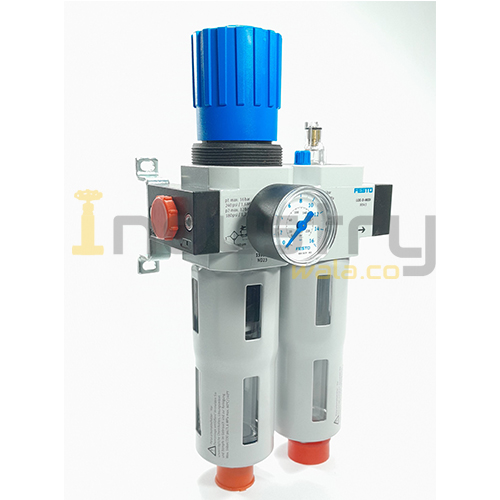
Brand : Festo
Model : MIDI
Body : Aluminum Pressure Die Cast
Element : Sinter Bronze (20 Micron)
Pressure : 10kg/cm2
Temperature : Upto 50 C
Media : Compressed Air
Click here to buy moisture separator.
Click here to buy Airmax FRL unit.
Click here to buy Aeroflex High Pressure 16KG/Cm2 FRL
Click here to buy Aeroflex FRL unit.
Price range: ₹5,199 through ₹8,999 Exclusive GST
You save (%)
A compressed air filter or air line filter is used to filter impurities from atmospheric air, like dust, oil and moisture, to make compressed air viable for use.
Just like air dryers, they are a crucial part of the air treatment process to make sure your compressed air is clean and safe to use, and to increase your equipment’s life span.
Proper air preparation significantly increases the process and production reliability of machines. Particles, water and oils in compressed air reduce the service life and functionality of components and systems. They also impair productivity and energy efficiency. In this article, a variety of air filtration and air treatment products are outlined and discussed, along with ancillary equipment like drains.
One cubic foot of compressed air can contain millions of dirt particles, considerable amounts of water and oil — and even heavy metals like lead, cadmium and mercury. If they are not filtered out, trouble-free operation of the system components, like valves and cylinders, cannot be guaranteed in the long term. Poorly prepared compressed air can contaminate control valves, and cause seals to swell and wear prematurely. As a result, the right compressed air preparation is essential for reducing machine downtime, and for reducing maintenance and energy costs.
Filters are used to remove particles, condensate and oil. Coarse / particulate filters have a pore size of 5 to 40 microns. The air flows past a centrifugal separator and then through the filter element. The filter elements are often a sintered material, like polyethylene or bronze.
Fine and micro filters remove particles smaller than 1 micron, down to 0.01 micron. The air flows through the filter cartridges from the inside to the outside. Solid particles get stuck in the filter cartridge, clogging it up. Fluid particles, such as condensate or oil, coalesce or attach to larger droplets, which flow off and are caught in the filter bowl. It is important to cascade your filters to avoid prematurely clogging the filter element. For example, if 1-micron filtration is needed, it is recommended to use a 5-micron filter upstream so that the 1-micron filter does not become clogged with larger particles.
Pressure regulators reduce and control fluid pressure in compressed air systems. Regulators are also frequently referred to as PRVs (pressure reducing valves). Optimally, a pressure regulator maintains a constant output pressure regardless of variations in the input pressure and downstream flow requirements.
 Festo MIDI G1/2 / G1/4 FRC Filter, Regulator, Lubricator FRL 1/4" & 1/2"
Brand : Airmax
Model- JHFRC-14A
Body : Aluminum Pressure Die Cast
Element : Sinter Bronze (20 Micron)
Pressure : 10kg/cm2
Temperature : Upto 50 C
Media : Compressed Air
Click here to buy moisture separator.
Click here to buy High Pressure 16KG/Cm2 FRL
Click here to buy Janatics FRL unit.
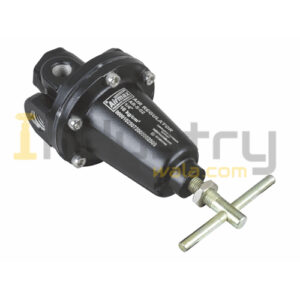
Brand : Standard Series Air Regulator
Model- AR-S-02
Body : Aluminum Pressure Die Cast
Bowl : P.C Bowl with Guard
Element : Poly Porous (25 Micron)
Pressure : 10kg/cm2
Temperature : Upto 50 C
Media : Compressed Air
For low cost Aeroflex make air regulator, click here.
For Janatics make air regulator, click here.
For Airmax make JH series air regulator, click here.
Click here to buy Airmax High pressure regulator (42Kg/cm2).
Click here to buy Mercury High pressure regulator (42kg/cm2).
Click here to buy Mercury High pressure regulator (80kg/cm2).

Brand: Airmax | Model: JHFRCLM-13
Body: Aluminum Pressure Die Cast
Filter Element: Sinter Bronze (20 Micron)
Pressure: 10 kg/cm² | Temp: Up to 50°C
Media: Compressed Air | Safety: Bowl Guard

We’ve been using the Festo MIDI G1/2 FRL unit in our air compressor line for the last 10 months. It delivers clean, dry, and regulated air consistently. The pressure adjustment knob is smooth, and the metal guard ensures durability. Perfect combination of performance and design!
The FRC FRL assembly from Festo offers excellent air filtration and lubrication for precision equipment. The 1/2″ port size provides sufficient airflow for multiple downstream valves. Pressure remains steady even under load changes. Compact and efficient unit!
This FRL combination works like a charm. We use the G1/4 variant for small control panels, and it maintains clean air flow without oil carryover. Build quality is top-notch, and the transparent bowl allows easy monitoring.
Festo FRL assemblies never disappoint. The G1/2” model handles heavy air flow effortlessly, and the regulator is extremely stable. The bowl design and drain system make servicing easy. Excellent unit for maintaining consistent pneumatic performance.
Good product from Festo with reliable performance. The MIDI FRC unit maintains correct air quality and ensures our actuators run smoothly. The lubricator setting is very accurate, and filter cleaning is straightforward. Definitely recommended for industrial use.